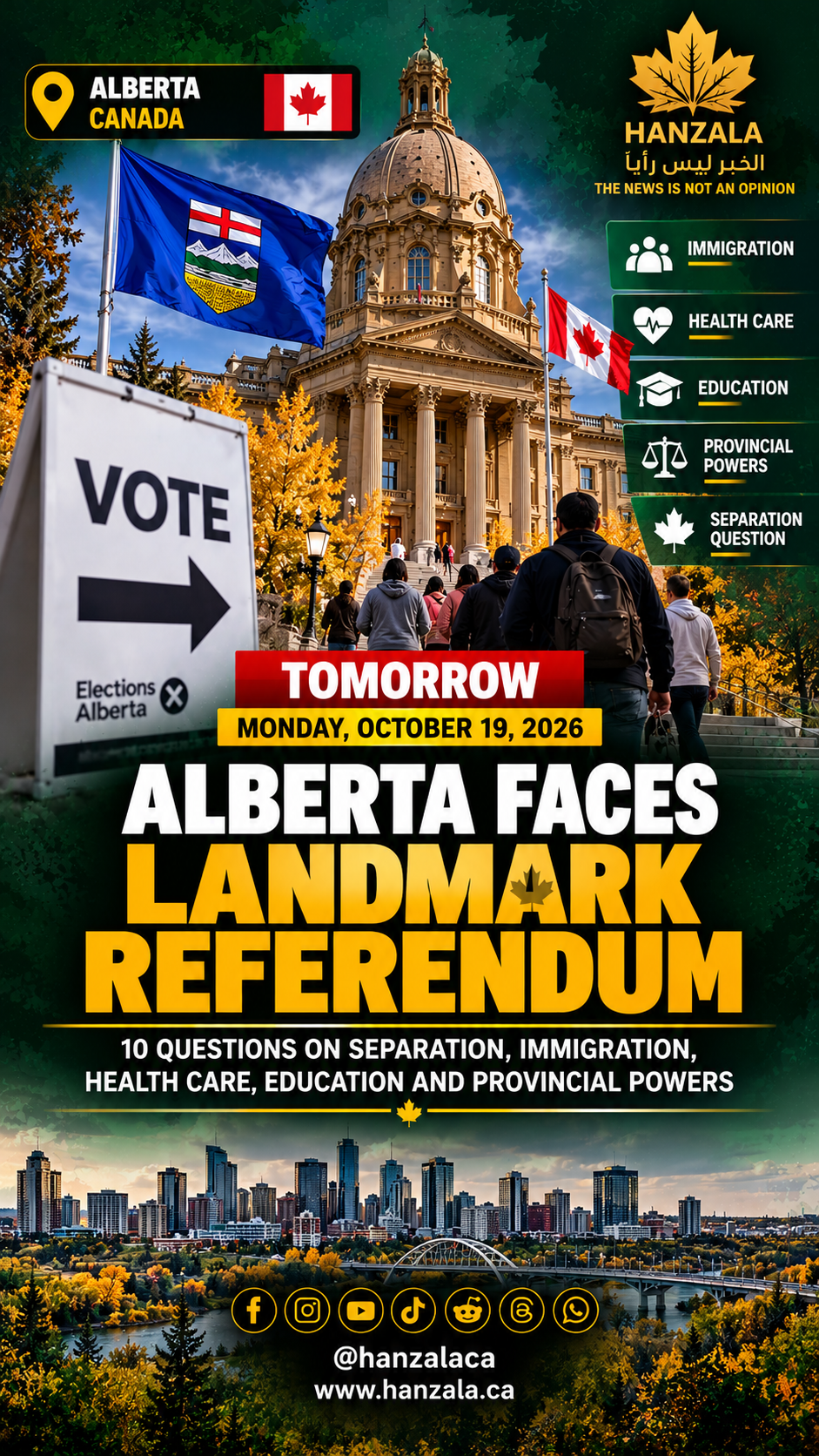
Edmonton – Alberta | October 18, 2026
The Canadian province of Alberta is preparing to hold a wide-ranging provincial referendum on Monday, October 19, comprising ten questions addressing the future of its relationship with the Canadian federation, immigration policies, access to public services, the powers of provincial governments, and constitutional amendments.
The question on whether to begin a legal process toward a binding referendum on Alberta’s separation from Canada is considered the most controversial, amid political and social differences over the province’s future and its role within the Canadian federation.
What are the ten questions Albertans will vote on?
The questions are divided into three main themes:
First: Immigration and public services — five questions
1. Immigration control and job opportunities: Should the Government of Alberta obtain broader powers in managing immigration, with the aim of reducing it to levels it considers more sustainable, and prioritizing economic immigration and Albertans for new job opportunities?
2. Eligibility for services: Should a law be enacted limiting access to provincially funded programs, including health, education and social services, to Canadian citizens, permanent residents, and persons holding an Alberta-approved immigration status?
3. One-year residency requirement: Should holders of temporary legal immigration status be required to reside in Alberta for no less than 12 months before accessing provincially funded social support programs, while citizens and permanent residents remain eligible under current rules?
4. Health and education fees: Should fees or premiums be imposed on holders of non-permanent immigration status and their families for the use of public health and education services, while citizens and permanent residents remain eligible?
5. Proof of citizenship to vote: Should proof of Canadian citizenship, such as a passport, birth certificate or citizenship card, be required to participate in provincial elections?
Second: Constitutional amendments — four questions
6. Appointment of judges: Do you support Alberta working with willing provinces to amend the Constitution so that provincial governments, rather than the federal government, select judges of the Court of King’s Bench and the Court of Appeal?
7. The Senate: Do you support working to amend the Constitution to abolish the unelected Senate of Canada?
8. Federal programs: Do you support enabling provinces to opt out of federal programs that intrude on their jurisdictions, such as health, education and social services, without losing the associated federal funding?
9. Paramountcy of provincial laws: Do you support amending the Constitution to give provincial laws priority over conflicting federal laws in areas of provincial or shared jurisdiction?
Third: Alberta’s future within Canada — the tenth question
Voters are asked to choose one of two paths:
* Alberta remaining a province within Canada. * Beginning the legal procedures required under the Canadian Constitution to hold a future binding provincial referendum on separation from Canada.
It is important to clarify that choosing the second path does not mean immediate independence for Alberta, but rather the start of legal and constitutional procedures that may require negotiations and a subsequent referendum.
Why is the referendum stirring wide controversy?
The Government of Alberta says some of the questions reflect the need to address the pressures of population growth on public services and to expand the province’s powers in managing its own affairs.
On the other hand, critics of the immigration-related proposals raise concerns about their impact on international students, temporary workers and their families, and the possibility of higher education and health care costs or new conditions for accessing certain services.
As for the separation issue, the debate is divided between supporters who believe Alberta needs greater leverage in dealing with Ottawa, and opponents who warn of the constitutional, economic and legal consequences of opening a path to separation.
Alberta Premier Danielle Smith affirms her support for the province remaining within Canada, while Canadian Prime Minister Mark Carney has called for preserving national unity.
Will the referendum results immediately become law?
No. The results of all ten questions are not legally binding.
However, they may carry political weight in setting the provincial government’s priorities and future negotiations with the federal government.
In addition, a number of the proposed changes, particularly the constitutional amendments and separation, cannot be implemented by a unilateral decision of the Government of Alberta, but are subject to additional legal and constitutional procedures and requirements.
Who is eligible to vote?
Those who meet the following conditions are eligible to vote:
* Be a Canadian citizen. * Be at least 18 years old on voting day. * Be ordinarily resident in Alberta.
Permanent residence, a work permit or a study permit alone does not confer the right to vote in this referendum.
When and where to vote
Polling stations open on Monday, October 19, from 9 a.m. to 8 p.m. Alberta time.
Voters must go to the polling station assigned to their residential address and bring the required documents proving identity and address.
The advance voting period ended on Saturday, October 17, while eligible unregistered voters are allowed to complete registration at their assigned station on voting day.
When will the results be released?
Vote counting is scheduled to begin after polls close, with unofficial results announced gradually over a period of up to 48 hours.
Priority will be given to counting the tenth question on Alberta’s future within Canada.
Official results are scheduled to be announced on October 29, 2026.
What does the referendum mean for Alberta’s future?
The referendum may mark an important political milestone in Alberta’s relationship with the federal government and in discussions on immigration, public services and constitutional rights.
However, the non-binding nature of its results means the vote will indicate trends in public opinion, and not necessarily immediate legislative or constitutional changes.
The key questions after the vote remain tied to the level of turnout, the results of each theme, and the steps the Government of Alberta may take in response to voters.
HANZALA Digital Media
News is not opinion
#ألبرتا #استفتاء_ألبرتا #كندا #الهجرة_إلى_كندا #إدمنتون